
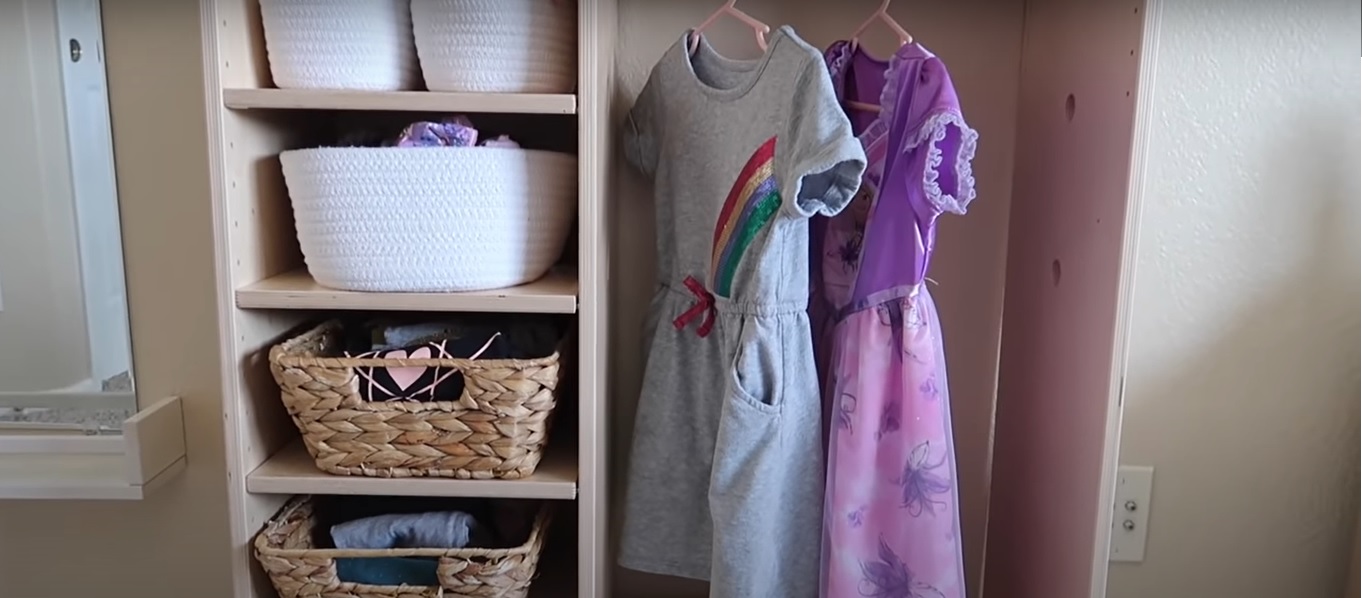
A Montessori closet in a nursery is a unique approach to organizing a child’s clothing and belongings. The Montessori method of education emphasizes independence, self-directed learning, and respect for a child’s natural development. A Montessori closet in a nursery aims to support these principles by creating an environment that allows children to choose and dress themselves independently.
Here is a little more about the Montessori approach:
The Montessori approach to education was developed by Maria Montessori, an Italian physician and educator, in the early 20th century. Montessori believed that children are naturally curious and capable of learning on their own, and that education should be tailored to meet the needs of each child. The Montessori method emphasizes independence, self-directed learning, and respect for a child’s natural development.
In a Montessori classroom, children are encouraged to explore and learn at their own pace. The classroom environment is carefully designed to promote independence and self-discovery, with materials and activities that are carefully selected to match the needs and interests of each child.
The Montessori approach also emphasizes practical life skills, such as caring for oneself and the environment. Children are taught how to dress themselves, prepare food, and clean up after themselves, among other practical skills.
Montessori education is often characterized by a hands-on, experiential approach to learning. Children are encouraged to explore and experiment with materials and activities, rather than simply memorizing facts or following instructions.
The Montessori approach is based on the idea that children learn best when they are engaged and interested in what they are learning. Montessori classrooms are designed to be nurturing, supportive environments that encourage children to explore, discover, and learn at their own pace.
Overall, the Montessori approach to education emphasizes respect for each child’s individuality and natural development, and aims to provide a supportive and stimulating environment that promotes independence, self-discovery, and lifelong learning.
Here are some key features of a Montessori closet in a nursery:
- Low Rods and Shelves:
A Montessori closet in a nursery typically features low rods and shelves that are accessible to a child. This allows children to see and choose their own clothes and accessories, promoting independence and decision-making skills. - Minimalistic Design:
A Montessori closet in a nursery often features a minimalist design, with a focus on functionality and simplicity. This helps to create a calm and organized environment that supports a child’s natural development. - Simple Organization:
A Montessori closet in a nursery is typically organized by category rather than by color or size. This helps children to develop a sense of order and to easily locate the items they need. - Child-Friendly Features:
A Montessori closet in a nursery may include child-friendly features, such as hooks at a child’s height, soft-closing drawers, and easy-to-open doors. These features help to promote independence and make it easier for children to access their belongings. - Accessibility:
A Montessori closet in a nursery is designed to be accessible to a child, with clothes and other items stored at a height that is appropriate for their age and development. - Open Shelving:
A Montessori closet in a nursery often features open shelving rather than closed drawers or cabinets. This helps to promote organization and allows children to easily see and choose their own clothes and accessories. - Quality Over Quantity:
A Montessori closet in a nursery emphasizes quality over quantity, with a focus on purchasing high-quality, durable items that will last for many years.
A Montessori closet in a nursery is a unique and innovative approach to organizing a child’s clothing and belongings. By promoting independence, self-directed learning, and respect for a child’s natural development, a Montessori closet in a nursery can help to create a nurturing and supportive environment that supports a child’s growth and development. If you’re interested in implementing a Montessori closet in your child’s nursery, consider working with a Montessori-trained professional or educator to ensure that your space is designed to meet the needs of your child and your family.
In a Montessori closet, the child is the focus. It is designed to promote independence and help children develop their self-care skills. By allowing children to choose their own clothes and accessories, a Montessori closet in a nursery can help children feel more in control of their environment and promote a sense of confidence and autonomy.
One of the key principles of a Montessori closet in a nursery is that it is designed to be accessible to a child. This means that clothes and other items are stored at a height that is appropriate for their age and development. The closet may also feature hooks and hangers that are easy for children to use, as well as soft-closing drawers and doors that are gentle on small fingers.
Another important feature of a Montessori closet in a nursery is that it is organized by category rather than by color or size. This helps children to develop a sense of order and to easily locate the items they need. For example, shirts may be grouped together, pants may be grouped together, and so on.
A Montessori closet in a nursery may also feature open shelving rather than closed drawers or cabinets. This helps to promote organization and allows children to easily see and choose their own clothes and accessories.
Additionally, a Montessori closet in a nursery may emphasize quality over quantity, with a focus on purchasing high-quality, durable items that will last for many years.
In conclusion, a Montessori closet in a nursery is a unique approach to organizing a child’s clothing and belongings that promotes independence, self-directed learning, and respect for a child’s natural development. By focusing on accessibility, simplicity, and quality, a Montessori closet in a nursery can help to create a nurturing and supportive environment that supports a child’s growth and development. If you’re interested in implementing a Montessori closet in your child’s nursery, consider working with a Montessori-trained professional or educator to ensure that your space is designed to meet the needs of your child and your family.